HomeResponsibility
RESPONSIBILITY — 責任ある企業へ
Measured by morethan profit.
Since 2024 the Parfun Group has been assessing itself against an international standard for social and environmental performance. We do not hold that certification yet.
外の、ものさし。
An outside measure.
A company can always tell itself it is doing well. In 2024 the Parfun Group decided to stop grading its own homework and began assessing itself against an international certification standard for social and environmental performance, one that examines governance, working conditions, diversity, human rights, climate, resource use, and how a company engages with the world beyond its own gate.
The first assessment was deliberately unflattering, and that was the point of it. It named the gaps precisely: environmental and social indicators that were managed but never reported, stakeholder voices heard informally but never collected, standards kept in practice but never written down.
An ESG Committee chaired at board level has met on that agenda since October 2024, with a standing ESG department reporting into it and ten working projects underneath: supplier engagement, human-rights survey, customer survey, internal reporting, information security, community work, diversity data. This page exists so that the work can be checked while it is still unfinished.
A garment passes through many hands before it reaches a shelf. Each pair of them has a claim on how we work.
Customers
お客様The brands that put their name on what we make. They audit us, and they increasingly ask us to prove what we claim, emissions figures included.
Colleagues & families
従業員とその家族Around 860 people across knitting, dyeing, cutting, sewing and inspection, and the households behind them. Conditions, harassment, pay and ethics are surveyed group-wide, and the results go to the committee rather than into a drawer.
Suppliers
サプライヤーYarn spinners, lace makers, dyestuff and trim vendors. Our largest suppliers have been asked, in writing, about wages, environmental practice and their own codes of conduct.
Neighbours
地域社会Samut Sakhon, Nakhon Pathom, and the towns our people commute from, including migrant workers from Myanmar. Steady employment where there was little is the plainest contribution we make.
The planet
地球環境Boilers, dyehouse water, offcuts and yarn waste. What we draw and what we return is measured at the mill, not estimated in an office.
Future generations
未来世代Whoever wears, washes and eventually discards this cloth twenty years from now. Making it last is the first environmental decision, before any certificate.
The standard groups its requirements into seven areas. Here they are in our own words, with what has been done, and what has not.
Purpose & governance
A stated purpose, a board that reviews social and environmental impact as a standing item, and a grievance route any stakeholder can use safely. The committee has met on this since October 2024; the policies that make it public are being drafted.
Fair work
A signed contract for everyone, pay-setting explained rather than assumed, and workplace culture measured. A group-wide employee survey has run across all sites, covering conditions, harassment, discrimination, whistleblowing, ethics and anti-corruption.
Diversity & inclusion
Gender and management ratios tracked, recruitment wording reviewed for language that quietly excludes, and Thai staff developed into group management through multi-year placements in Japan. This website is being built to meet accessibility standards as part of the same commitment.
Human rights
A published human-rights position, salient risks identified across the value chain, and a route for raising harm that reaches the committee. Group regulations already exist in Japanese, English, Thai and Burmese, so that the people they protect can read them.
Climate
Converting the fabric mill’s boilers from coal to natural gas cut CO₂ emissions by roughly 70%. Scope 1, 2 and 3 accounting is under way; a published climate plan with dated targets is the next step, not a finished one.
Resources & circularity
Dye water purified on site before it returns to the river. Yarn waste re-fiberised into recycled yarn with a partner mill. Small-body and tubular patterns that cut cloth waste before it exists, rather than recycling it afterwards.
Collective action
Environmental material development run jointly with customers rather than alone, and a written position on responsible advocacy. Certification, when we reach it, is a way of joining that conversation, not the end of it.
Evidence, not intention.
The certification described on this page is not held, not pending and not claimed. What follows is the part that has already been verified by someone other than us.
Environmental management has been certified since 2013: KES first grade in Japan, then ISO 14001. Quality management runs under ISO 9001. Labour practice at the factory is verified under WRAP, security under Intertek GSV, and environmental performance at the mill is measured through the Higg Facility Environmental Module. Thailand’s Ministry of Industry rates the site Green Industry Level 3.
Everything beyond this, from published policies and emissions figures to survey results and dated targets, is being prepared with our advisers and will appear here as each one is approved, and not before.
Standards & certifications
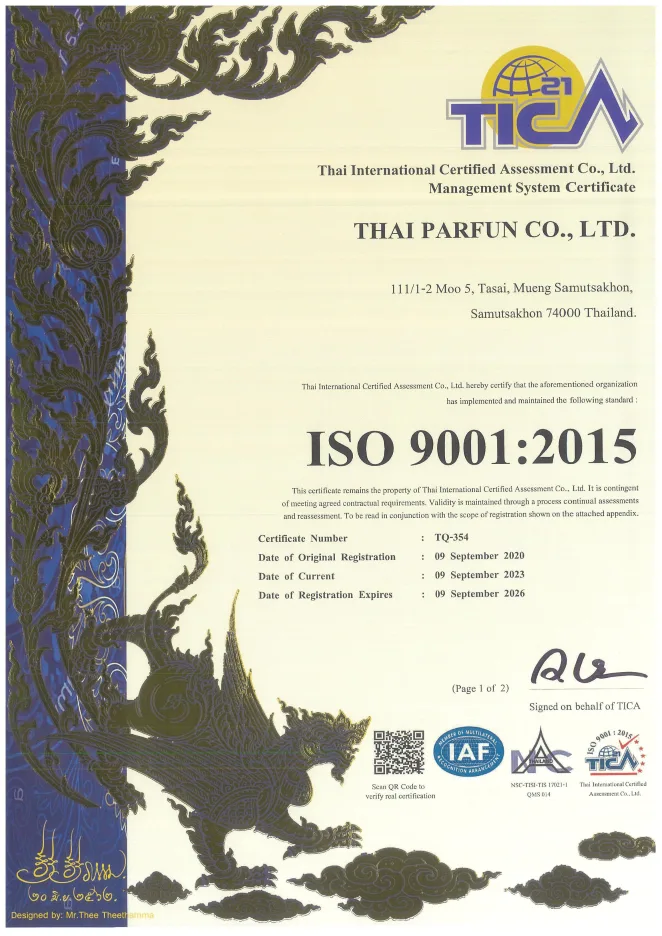 ISO 9001:2015Thai International Certified Assessment (TICA)Quality management, audited across the Samut Sakhon factory.
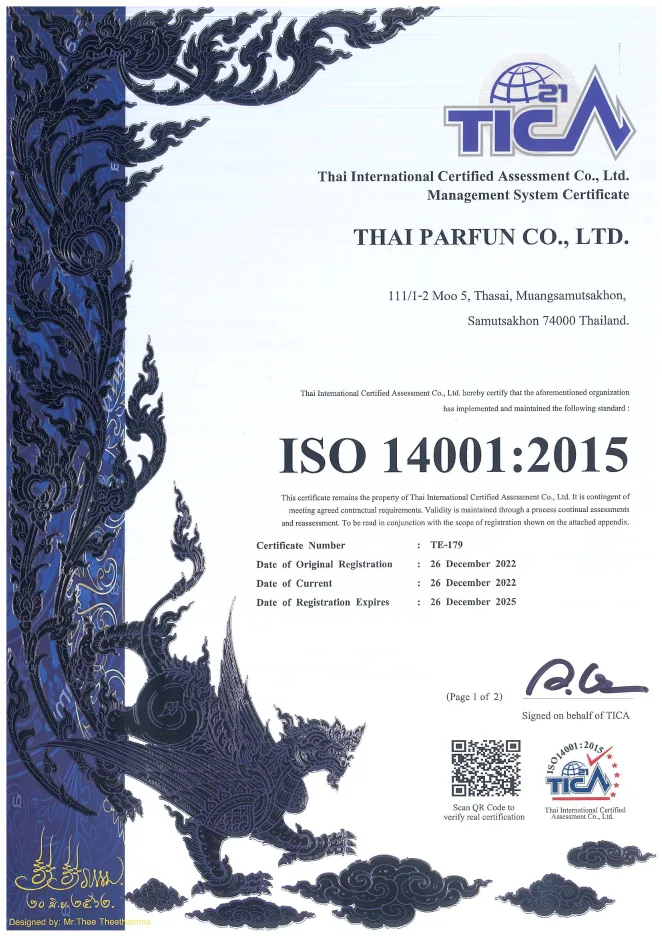 ISO 14001:2015Thai International Certified Assessment (TICA)Environmental management: water, waste and emissions.
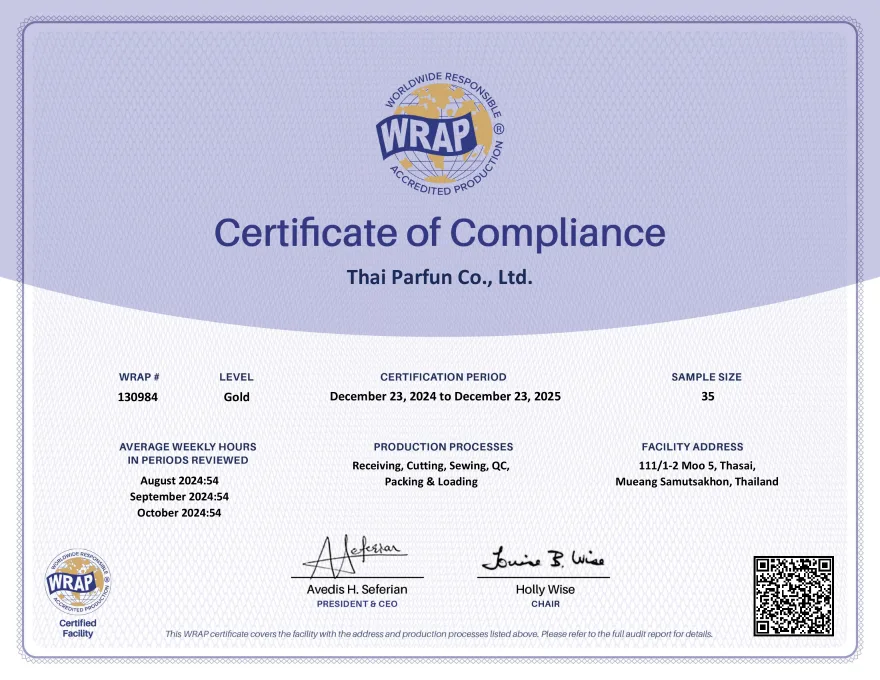 WRAP GoldWorldwide Responsible Accredited ProductionLawful, humane and ethical manufacturing: receiving, cutting, sewing, QC, packing.
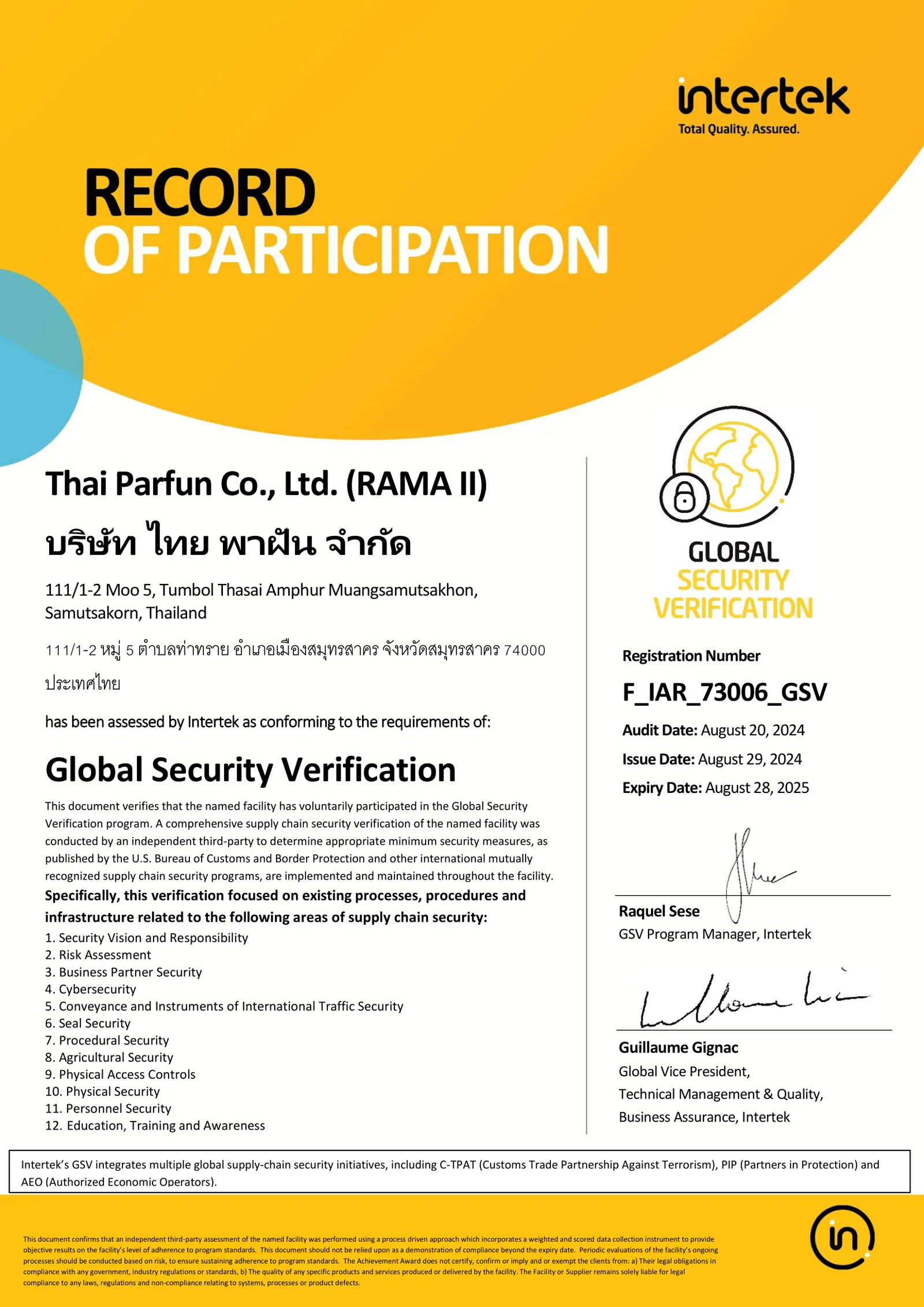 Global Security VerificationIntertekSupply-chain security, assessed against C-TPAT, PIP and AEO requirements.
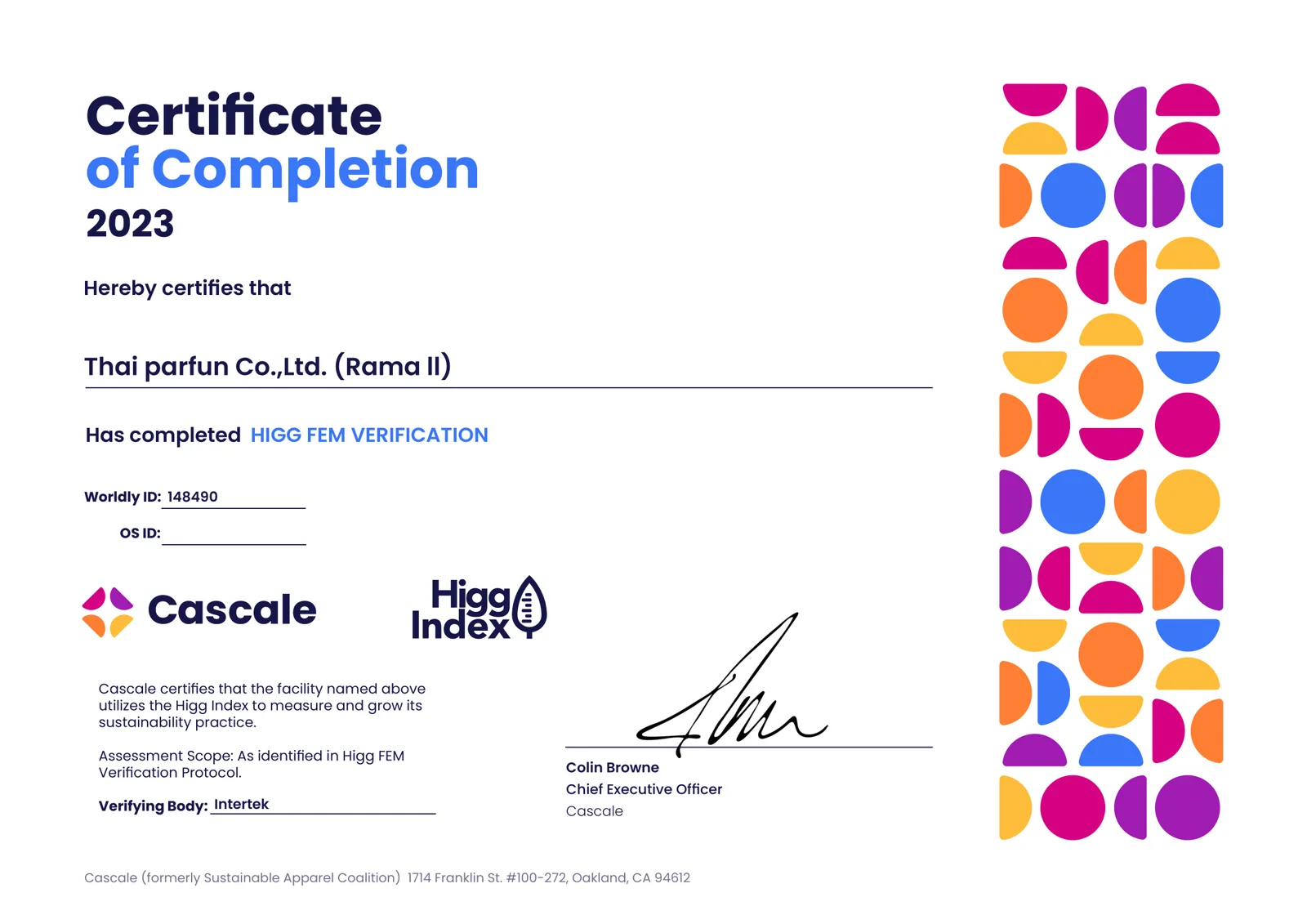 Higg FEM VerificationCascale, verified by IntertekFacility Environmental Module, measured and then independently verified.
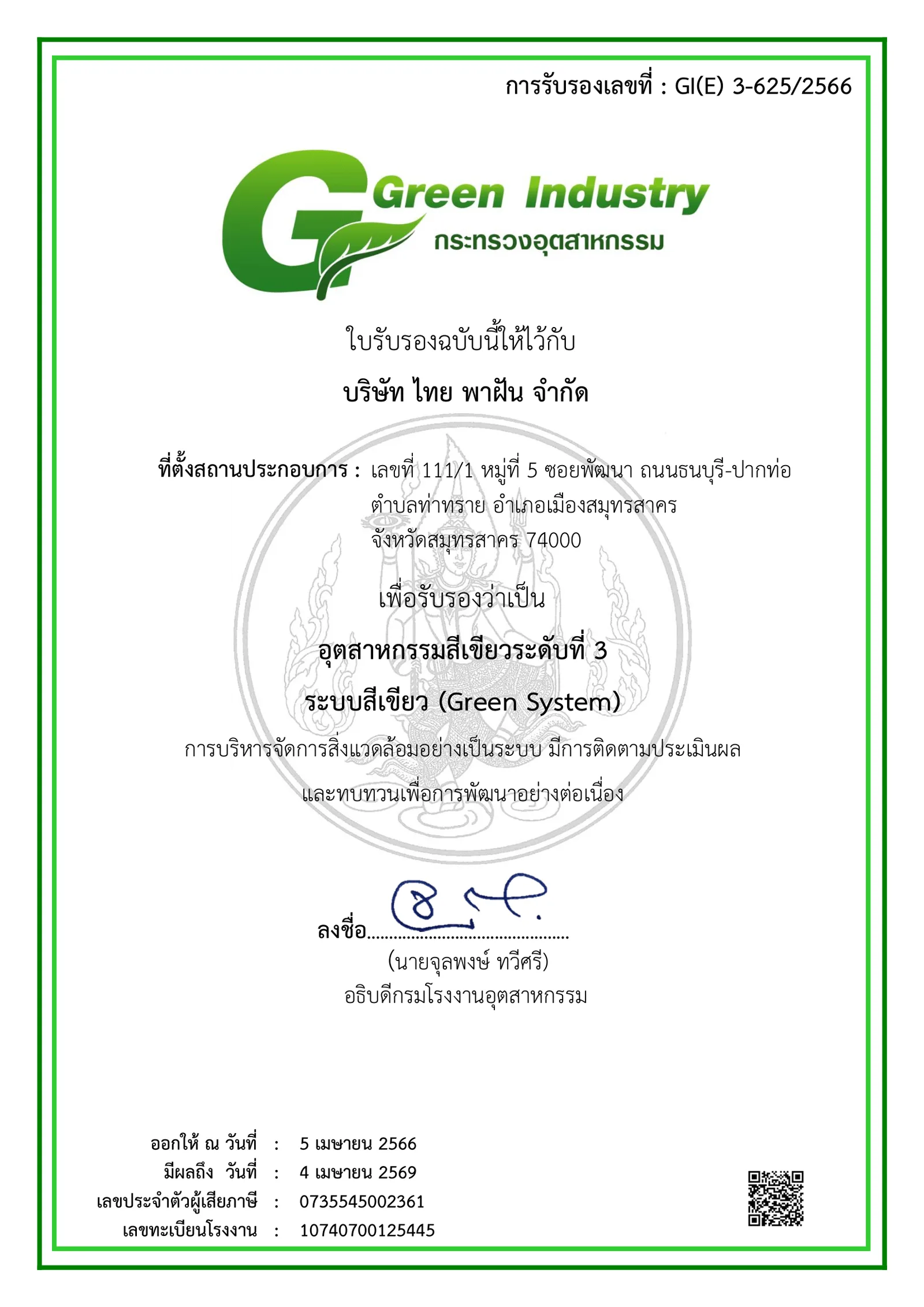 Green Industry — Level 3Ministry of Industry, ThailandGreen System: environmental management run, reviewed and improved continuously.
What this looks like in cloth.
Boilers, dye water, offcuts and ocean plastic: the environmental half of the same commitment, in detail.